

Why Did I Get a 1099-K? What Small Business Owners and Side Hustlers Need to Know

If you opened your mail or checked your tax documents and found a 1099-K, you may have asked yourself: "Why did I get this?"
You're not alone.
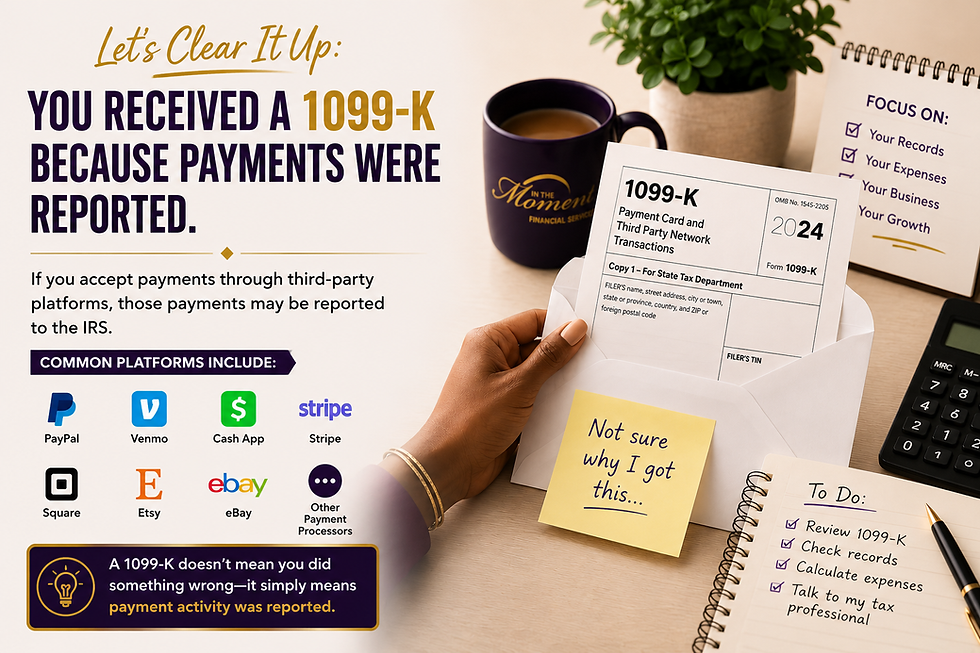
This has become one of the most common questions we hear from small business owners, freelancers, side hustlers, and anyone getting paid through digital payment platforms.
The good news is that receiving a 1099-K doesn't necessarily mean you've done anything wrong. It simply means certain payment activity was reported. Read on to learn everything you need to know about 1099's and what to do next.
What Is a 1099-K?
A 1099-K is a tax form used to report payments processed through third-party payment platforms and payment cards.
You may receive a 1099-K if you accept payments through platforms such as:
PayPal
Venmo
Cash App
Stripe
Square
Etsy
eBay
Other online payment processors
The purpose of the form is to report payment activity that may be related to business income.
Why Did I Receive a 1099?
The most common reason is simple:
You received payments for goods or services through a payment platform.
For example:
You own a small business
You freelance or consult
You sell products online
You offer beauty, coaching, or creative services
You operate a side hustle
If customers paid you electronically, those payments may have been reported.
Does Receiving a 1099-K Mean I Owe More Taxes?
Not necessarily.
A 1099-K reports payment activity, but it doesn't automatically determine how much tax you owe.
Your actual tax liability depends on factors such as:
Your income
Business expenses
Deductions
Other tax credits and circumstances
The form is simply one piece of the puzzle.
What If the Amount Looks Too High?
This is where many people get confused.
A 1099-K often reports gross payments received, not profit.
For example:
Let's say you received $25,000 through a payment platform.
That doesn't necessarily mean you made $25,000 in profit.
You may have had:
Business expenses
Refunds
Fees
Cost of goods sold
This is why accurate bookkeeping is so important.
Your tax return should reflect your actual business income and allowable expenses—not just the number shown on a 1099-K.
What If I Didn't Receive a 1099-K?
This is another common misconception.
Many people assume:
"If I didn't get a tax form, I don't have to report the income."
That's not true.
Business income is generally reportable whether you receive a tax form or not.
The responsibility to report income doesn't depend on whether a form arrives in the mail.
What Should You Do If You Receive a 1099-K?
Don't panic.
Instead:
Review the amount reported.
Compare it to your own records.
Make sure your bookkeeping is up to date.
Keep documentation of your income and expenses.
Work with a tax professional if you're unsure how the form should be reported.
The Bottom Line
As payment apps and digital transactions become more common, more business owners are receiving 1099-K forms than ever before.
The important thing is understanding what the form does—and doesn't—mean.
A 1099-K doesn't automatically mean you owe more taxes. It simply means certain payment activity was reported.
The best way to avoid confusion is to keep accurate records throughout the year and stay organized long before tax season arrives. When your books are in order, forms like the 1099-K become much easier to manage. Need advice? It may be time to book a tax consultation to meet with our experts! Talk soon!


Comments